

Cage-Free Dog Boarding vs Traditional Kennels: Key Differences
Cage-free dog boarding lets your dog rest, play, and socialize in open, home-style rooms with raised beds and supervised group time, while traditional kennels keep each dog separated in an individual cage or run for most of the day. The biggest day-to-day differences come down to how much your dog moves, sleeps, and interacts with people and other dogs.
In a traditional kennel, your dog spends 18 to 22 hours a day confined to a small space, with short scheduled walks or yard time in between. In a cage-free environment like Bestland Dog Boarding and Pet Resort on our peaceful 40-acre farm near Rome, GA, your dog has access to soft raised bedding, shaded outdoor paddocks, enrichment, and small-group play throughout the day. For most social, well-adjusted dogs, that difference shows up in better sleep, less stress, and a calmer return home.
Here’s what actually changes for your dog when you choose one over the other.
What Is Cage-Free Dog Boarding?
Cage-free dog boarding (sometimes called kennel-free or open boarding) is a style of care where dogs are not confined to individual cages or crates for most of the day. Dogs live in supervised, home-style indoor spaces with raised soft beds, toys, and group play access, often with paddocks or yards for outdoor time.
A few common features of cage-free boarding:
- Open indoor rooms or cottage-style spaces rather than rows of cages
- Raised soft bedding, blankets, or couches for resting
- Small, supervised play groups based on size and temperament
- Hands-on staff who handle play, rest, and feeding throughout the day
- Required meet and greet or temperament screening before the first stay
- Lower total guest capacity per facility
The model focuses on giving dogs the structure and routine they need without the stress of long-term confinement.
What Is a Traditional Kennel?
A traditional boarding kennel houses each dog in its own cage, crate, or fenced run. Dogs eat, sleep, and spend the majority of their time inside that individual space. Staff rotate dogs out for scheduled feeding, walking, and limited play, often a few short sessions per day.
Typical features of a traditional kennel:
- Rows of indoor cages or covered runs
- Concrete or rubber-mat flooring
- Scheduled potty breaks and short walks
- Separation from other dogs except during brief, optional play sessions
- Higher total dog capacity per facility
- Often attached to a veterinary clinic, grooming shop, or pet retailer
Traditional kennels remain widely available and predictable. Many include medical monitoring as a built-in feature, especially if attached to a vet clinic.
Cage-Free vs Traditional Kennel: Side-by-Side
Feature | Cage-Free Boarding | Traditional Kennel |
Daily confinement | Minimal, mostly during sleep | 18 to 22 hours per day |
Sleeping area | Raised soft beds, open rooms | Inside a cage or run |
Group play | Built into the daily routine | Optional or add-on |
Staff interaction | Hands-on throughout the day | Scheduled only |
Noise level | Quieter, smaller groups | Often loud, more barking |
Capacity | Small, limited guests | Larger, more dogs at once |
Pre-stay screening | Meet and greet required | Often not required |
Best fit | Social, well-adjusted dogs | Reactive or medically fragile dogs needing isolation |
The simplest way to think about it: a traditional kennel is a place to stay; a cage-free resort is a place to live for a few days.
How Each Affects Your Dog's Stress and Behavior
Dogs are creatures of routine. When their routine breaks, you often see pacing, whining, refusing food, or destructive behavior. The boarding environment you pick has a direct effect on how much of that stress your dog carries during the stay and brings home with them.
In a traditional kennel, constant barking, scent of other anxious dogs, and confinement can push stress levels up. Many dogs come home and sleep heavily for a day or two, hoarse from barking or worn down from disrupted sleep.
In a cage-free setting, dogs have more freedom to choose how they spend their time. They can lie down, stretch out, watch other dogs play, or join in. Smaller groups and consistent staff mean less noise and more predictable interactions. Dogs tend to settle in faster and recover quicker once they get home.
This matters most for:
- Dogs with separation anxiety
- Rescue dogs with prior shelter or crate trauma
- High-energy breeds that pace when bored
- Sensitive dogs who shut down in loud environments
The Sleep and Rest Difference
Sleep is one of the most overlooked parts of boarding. A poorly rested dog comes home tired in the bad way: cranky, off their food, and slow to bounce back.
Traditional kennels are often noisy 24 hours a day. Barking carries between runs, lights stay on for staff visibility, and floor surfaces are hard. Some dogs adjust, but many never get a full sleep cycle.
Cage-free facilities are typically quieter because dogs aren’t barrier-frustrated. They have raised soft beds, often in climate-controlled rooms, and they choose where to rest. At Bestland, our indoor spaces are designed to feel like a home rather than a holding area, so dogs settle into a real sleep rhythm.
Socialization and Activity Level
A traditional kennel limits your dog’s social and physical activity to whatever the staff schedules. Some kennels include play time, but many charge for it as an extra. Active dogs left in cages for long stretches often develop “kennel pacing” or barrier reactivity.
In cage-free boarding, play and socialization are part of the daily rhythm. Dogs are grouped by size, energy level, and temperament, then supervised by staff trained to read body language. Dogs leave mentally engaged and physically tired in the good way.
At Bestland, dogs rotate between six large shaded outdoor paddocks and indoor rest space throughout the day. Open skies, real grass, and country air give them something a kennel simply can’t replicate.
Health and Illness Risk
Both boarding styles require current vaccinations and clean facilities, but the health profile of each is a little different.
Traditional kennels:
- Higher density of dogs in shared airspace
- Slightly higher exposure risk for kennel cough and respiratory infection
- Easier individual isolation for medical needs
- Often attached to vet clinics for immediate care
Cage-free facilities:
- Smaller groups and open ventilation reduce shared-air exposure
- Closer staff observation catches early signs of illness
- Better suited for dogs on medications or special diets that need flexible timing
- Less ideal for dogs who must be physically isolated for medical reasons
Bestland reviews vaccination records before every stay and accommodates special diets and medications at no added cost.
Which Dogs Do Better in Cage-Free Boarding?
Cage-free boarding is a strong fit for most dogs, but it’s not for every single dog. The right candidates are usually:
- Social dogs who enjoy other dogs’ company
- Anxious dogs who do poorly in loud, crowded environments
- Senior dogs who need soft bedding and quiet surroundings
- High-energy dogs who need room to move
- Dogs that have struggled or come home shut down from traditional kennels
- Dogs with mild medical needs that benefit from hands-on staff
Most cage-free facilities, including Bestland, require a meet and greet before the first stay. This is a no-pressure visit where we observe your dog’s temperament and make sure cage-free is the right fit for them.
When a Traditional Kennel Might Still Make Sense
Traditional kennels still serve a purpose. They tend to be the better choice when:
- Your dog is reactive or aggressive toward other dogs
- Your dog needs strict physical isolation for a medical condition
- Your dog is recovering from surgery and must be confined
- You need 24-hour on-site veterinary monitoring
If your dog falls into one of those groups, a vet-attached kennel can be safer. For the vast majority of social, healthy dogs, though, cage-free is the calmer, less stressful option
What Cage-Free Boarding Looks Like at Bestland
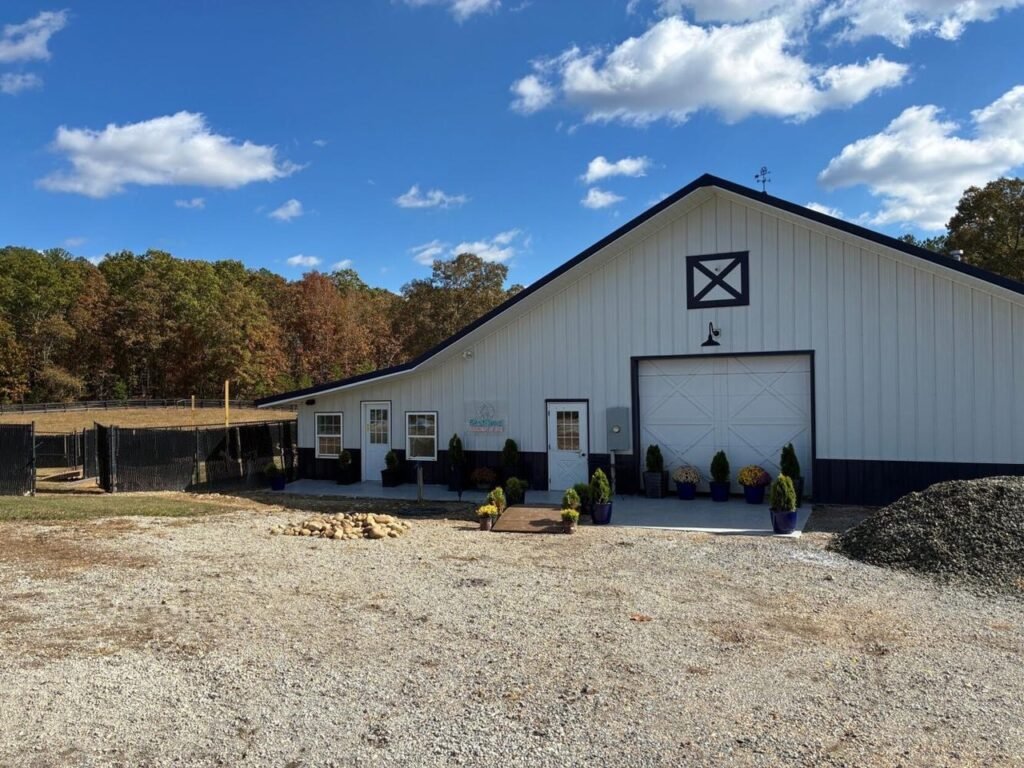
Bestland is a family-run, cage-free dog boarding resort on a 40-acre farm just outside Rome, GA. Jeremy, Marcela, and their five children built it for one reason: to give dogs a kinder alternative to the loud, crowded kennel experience.
Here’s what your dog gets:
- A crate-free, climate-controlled indoor space with raised soft bedding
- Access to six large shaded outdoor paddocks with real grass
- Personalized daily routines based on your dog’s habits at home
- Small group play matched by size and temperament
- Hands-on care from a family with 15-plus years of dog experience
- Special diets, medications, and senior care at no added cost
- A required meet and greet so we know your dog before their first stay
Doggy daycare follows the same model. If you want your dog to spend the day with a small group of other pups in a peaceful country setting, our dog daycare program is a good fit.
For a closer look at the rooms, paddocks, and routines, take a tour of our facility or read our About Us page to meet the family behind Bestland.
How to Reach Us
Location
2500 Euharlee Rd SE, Rome, GA 30161
Hours
We’re available by phone or email daily from 7am to 5pm
Ready to Try a Cage-Free Stay for Your Dog?
Book Your Meet and Greet at Bestland Dog Boarding and Pet Resort
Call (770) 709-8497 to schedule a meet and greet for your dog. Bestland serves families across Rome, Cartersville, Cave Spring, Lindale, Armuchee, Adairsville, Calhoun, and nearby areas of Northwest Georgia. We keep our guest count small so every dog gets real one-on-one attention, which means spots fill up early, especially around holidays.
Book Your Dog’s Meet and Greet